
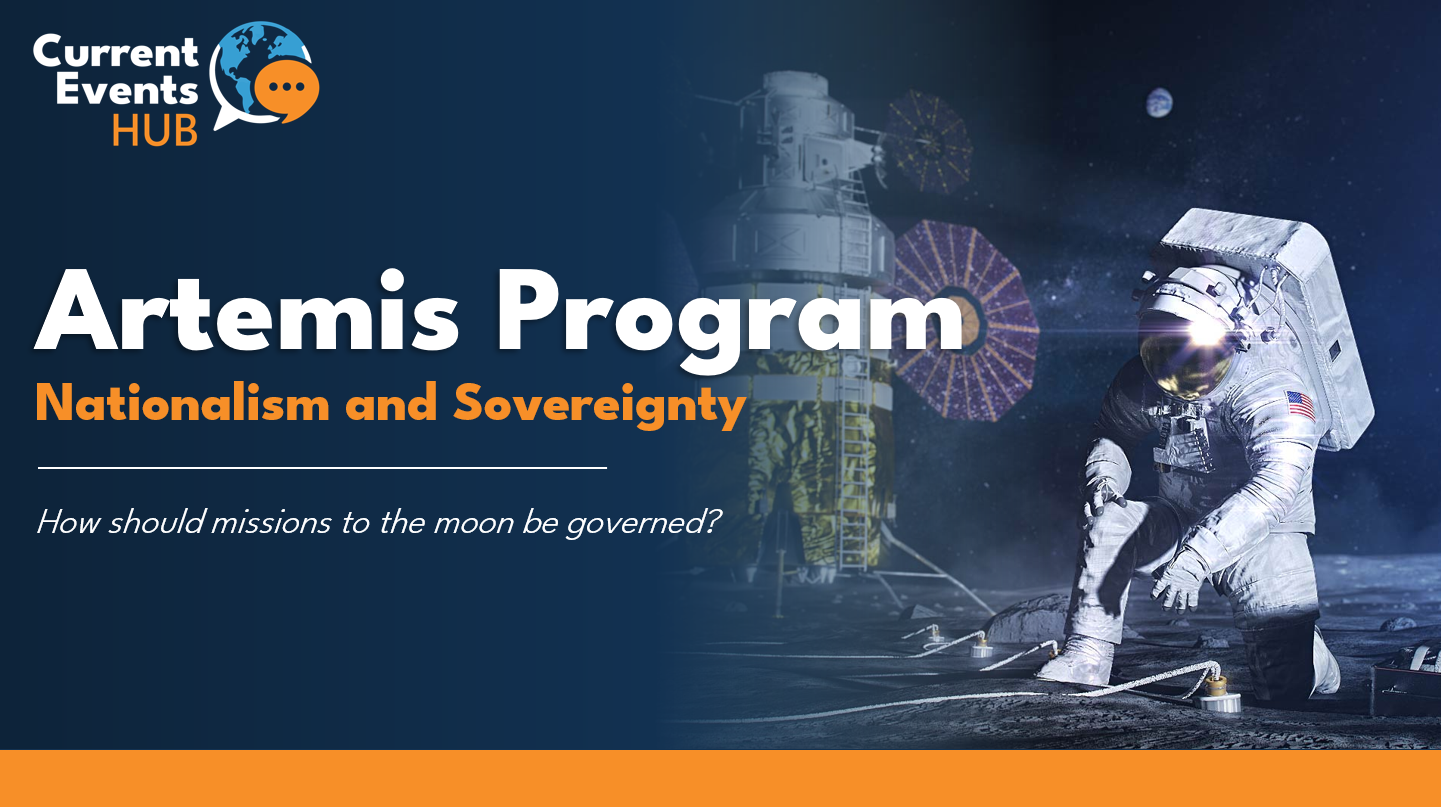
On April 1, 2026, humans headed toward the Moon for the first time in over 50 years. NASA’s Artemis II mission isn’t just a technological achievement. It’s a window into nationalism, sovereignty, and the race to control space. This classroom-ready lesson includes three differentiated readings (Grades 6–12), tiered discussion questions, a structured critical thinking task, and full teacher notes. Perfect for Social Studies, Global Politics, and Humanities classes exploring how science, power, and international law collide beyond Earth.
Included in this lesson:
- PowerPoint Slides with concept intro, discussion, and current event overview
- A separate ready-to-print PDF document for each lesson level
- Thinking questions to connect to the concepts of nationalism and sovereignty
- Critical thinking activity about governance on the moon
- Research extension about the 1967 Outer Space Treaty
Lesson File Downloads:
Supporting Information:
Lesson Sources and Further Reading
Teacher Notes and Differentiation Tips
Key Misconceptions to Address
- “The US owns the Moon because it got there first.” The Outer Space Treaty (1967) explicitly prohibits national appropriation — being first creates no legal claim. This is worth dwelling on, as it surprises many students.
- “Space exploration is purely scientific.” Help students see that mission selection, crew composition, naming choices (“Artemis”), and treaty frameworks are all political acts, not just logistical ones.
- “China and the US are in conflict.” The rivalry is real but not militarised (yet). The distinction between competition and conflict is analytically important for Level 3 students especially.
Sensitivity Risks
- Anti-Chinese or anti-American sentiment from students who frame this as a “good guys vs bad guys” binary. Redirect to: “Both programs describe themselves as peaceful and scientific — what does that tell us about how nations use language?”
- Students from China, the US, Canada, or any Artemis Accords nation may feel personally invested. Use the diversity of the crew and the involvement of 60+ nations to model that this story involves people from everywhere.
- The crew’s demographic composition (first person of colour, first woman in deep space) is worth discussing but can veer into US domestic culture war territory. Keep the frame on what signals nations choose to send through representation rather than domestic politics.
Differentiation Tips
- Level 1 students may benefit from a map showing countries that have signed the Artemis Accords vs. the ILRS — visual geography grounds the concept.
- Level 3 students can be pushed to engage with the actual text of the Outer Space Treaty Article II and the Artemis Accords Section 10 (resource utilisation) — both are publicly available and short enough to excerpt.
- Strong Level 3 students: assign the PBS/Conversation article contrasting Artemis with China’s program as a pre-reading or extension.
Curriculum Links
C3 Inquiry Arc Constructing compelling questions about how international law applies in new domains; evaluating sources and perspectives on contested sovereignty claims.
Common Core Literacy — History/Social Studies Determining central ideas; evaluating authors’ points of view and purpose; citing textual evidence in argument writing.
IB MYP Global Context: Globalisation and Sustainability. Key Concepts: Systems, Perspective. ATL Skills: Critical and creative thinking, Research.
IB DP Global Politics Power, sovereignty, and international relations; global governance and the UN system.
AP Government / Comparative Politics Foreign policy, international institutions, comparative state power.
GCSE / A-Level Global governance and international institutions; political ideologies and nationalism; contemporary geopolitical issues.
Canadian Provincial — Social Studies Global citizenship; identity, culture and community; power and authority in democratic and non-democratic contexts.
Australian Curriculum — HASS Civics and Citizenship: how international agreements shape governance. Geography: global commons and resource management.
Transferable Skills Sourcing and perspective-taking · Claim-evidence-reasoning · Structured academic controversy · Civic and media literacy
How to Use Current Events Hub Lessons
This lesson is designed for mixed-ability classrooms and comes ready in three reading levels — so you can use one level with the whole class or differentiate across groups without extra prep.
Choose your timing:
| Format | Time | What’s included |
|---|---|---|
| Quick snapshot | ~20 min | Slides or reading + comprehension questions |
| Full lesson | ~60 min | Slides + reading + thinking activities |
| Extended inquiry | ~80 min | Full lesson + research extension task |
Simple Plans for Individual Teachers and Departments
Individual Monthly
$12/month
Full access to the lesson library
A flexible way to explore
Individual Annual
$99/year
One-week free trial
Best value for individual teachers
Department Annual
$249/year
Up to ten teachers with unique logins
Ideal for school budgets