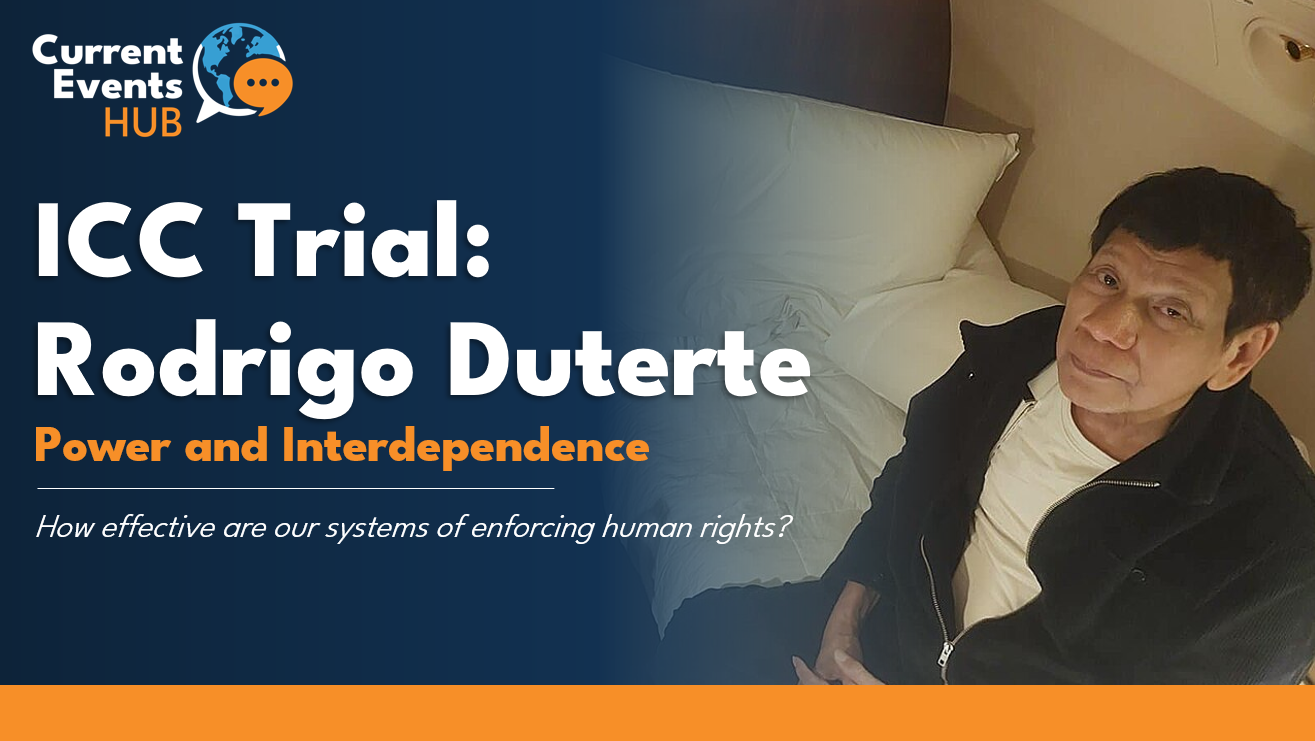
When a government commits serious human rights abuses, accountability rarely comes quickly – or from a single source. This lesson uses the Philippines drug war under President Rodrigo Duterte as a case study to examine two key actors in the human rights system: an NGO – Human Rights Watch and an IGO – the International Criminal Court (ICC). Students explore what each organization can and cannot do, how their roles complement each other, and why it still took nearly a decade for Duterte to face trial.
This lesson includes differentiated readings in three levels for Grades 6-12, tiered discussion questions, and a structured critical thinking comparison task included. A strong fit for units on rights, the effectiveness of global institutions, justice and accountability.
Included in this lesson:
- PowerPoint Slides with concept intro, discussion, and current event overview
- A separate ready-to-print PDF document for each lesson level
- Thinking questions to connect to the concepts of power and interdependence
- Critical thinking activity about the effectiveness of human rights enforcement
- Research extension about other ICC cases
Lesson File Downloads:
Supporting Information:
Lesson Sources and Further Reading
Teacher Notes and Differentiation Tips
Key Misconceptions to Address
- “NGOs are just protest groups.” Students often conflate NGOs with protesters or lobbyists. HRW’s methodology in this case was rigorous and thorough, comparing official police records against witness testimony, working with legal frameworks, and producing documentation later used by prosecutors.
- “The ICC found Duterte guilty.” Reinforce that confirmation of charges is not a verdict. The trial has not yet begun. Presumption of innocence applies.
- The ICC is all-powerful.” Students frequently assume international courts can act like domestic courts by issuing orders that are automatically enforced. The ICC has no police. Omar al-Bashir of Sudan evaded ICC arrest warrants for over a decade. Duterte’s arrest happened because the Philippine government cooperated – not because the ICC compelled it.
- “HRW’s report caused Duterte’s arrest.” No single document or organization caused the arrest. The report was one essential part of a larger investigation.
Sensitivity Risks
- Students with Filipino backgrounds. This event remains divisive. Duterte retains supporters who view the drug war as necessary and the ICC as foreign interference. Do not assume any Filipino student shares a single view.
- Emotional weight of victim stories. The HRW report contains accounts of children being killed. The lesson as written does not include graphic details. If students access the original report independently, be prepared to acknowledge the emotional weight without dwelling on graphic content in class discussion.
Differentiation Tips
- Level 1 support: Provide a simple two-column scaffold before reading: “HRW: what it can do / what it cannot do” and “ICC: what it can do / what it cannot do.” Students fill it in as they read.
- Level 2/3 extension: Ask students to find one other example of an NGO report that contributed to a later legal or political accountability process (e.g. Amnesty International on apartheid South Africa; HRW on the Rwandan genocide).
- Level 3 extension: Assign the actual ICC jurisdiction ruling summary (available at icc-cpi.int) alongside the HRW “License to Kill” HRW report. Ask students to trace how the language of research and documentation migrates into legal framing.
- ELL support: Pre-teach “NGO,” “jurisdiction,” and “documentation” with visual definitions and concrete examples before distributing readings.
Curriculum Links
IB MYP Individuals & Societies: key concept — change; related concepts — equity, governance; global context — fairness and development; objectives A: Knowing and understanding, D: Thinking critically.
IB DP Global Politics: key concepts — legitimacy, interdependence, power; thematic study: Rights and justice (codification, monitoring, and responses to violations; UDHR 1948; R2P); thematic study: Peace and conflict (justice institutions, e.g. the ICC); core topic: global governance and the roles of IGOs and non-state actors; AO3 command terms — evaluate, to what extent.
C3 Framework (US): D2.Civ Civic and Political Institutions (evaluating the effectiveness of institutions); D3 Evaluating Sources and Using Evidence; D4 Communicating Conclusions and Taking Informed Action (grades 6–8 and 9–12 indicators).
Common Core Literacy in History/Social Studies: RH.6 compare authors’ points of view and purpose; RH.9 integrate and compare primary and secondary sources (HRW report vs. ICC ruling); RH.8 assess whether evidence supports a claim; WHST.1 write arguments from discipline-specific content.
AP Comparative Government & Politics (concept-level — no anchor-country tie): Big Ideas — Legitimacy and Stability (LEG), Internal/External Forces (IEF); state sovereignty vs. supranational pressure; Disciplinary Practice 5 Argumentation.
GCSE Citizenship Studies (Edexcel, 1CS0): Theme D Power and influence (the UK in the wider world — UN; international humanitarian law; the role of NGOs); Theme A Living together in the UK (development of human rights — UDHR, ECHR); AO3 analyse and evaluate.
A-Level Politics (Edexcel, 9PL0): Component 3 Comparative Politics — Global Politics (international law and human rights; the role of non-state actors; sovereignty vs. international obligation).
British Columbia Social Studies 10 (Canada and the World: 1914 to the Present): Content (international conflict and co-operation — UN; human-rights advocacy); Curricular Competencies — cause and consequence, ethical judgment. (Level 2/3)
British Columbia Social Justice 12: Big Ideas (social justice issues are interconnected; initiatives can transform individuals and systems); Content (governmental and non-governmental organizations in justice and injustice; methods used to promote social justice); Curricular Competency — ethical judgment. (Level 3)
Alberta Social Studies 20-1/2: Related Issue 3: To what extent should internationalism be pursued? (motives for pursuing internationalism — peace, security, humanitarianism — 3.4; the role of international organizations and international law; internationalism vs. national interest and sovereignty); strands — Power, Authority and Decision Making, Global Connections; Skills S.1 critical thinking, S.7 deliberative inquiry; “to what extent” evaluation. (Level 2/3)
New Brunswick World Issues 120 (Grade 12): Geopolitics — evaluate solutions to violations of human rights (individual vs. collective rights; advocacy; NGO and IGO efficacy); assess social-justice initiatives from governments, NGOs, and individuals.
Nova Scotia Global Politics 12: Unit 4 International Relations (5.2 organizations governing global relations — UN; 5.5 obstacles to international relations); Global Citizen (1.1 critically investigate a contemporary global political issue).
Ontario Canadian and International Politics (CPW4U): concepts of political thinking — political significance, stability and change, political perspective; inquiry process applied to international institutions and global governance.
Australia HASS — Civics & Citizenship (v9): Laws and citizens (international law; human rights; roles of international organisations); Government and democracy; skills — Analysis, evaluation and interpretation.
New Zealand — Social Sciences (Te Mātaiaho, Phase 4): Civics and Society — human rights (UDHR; international human-rights bodies and their reach); practice — use sources to weigh competing perspectives.
How to Use Current Events Hub Lessons
This lesson is designed for mixed-ability classrooms and comes ready in three reading levels — so you can use one level with the whole class or differentiate across groups without extra prep.
Choose your timing:
| Format | Time | What’s included |
|---|---|---|
| Quick snapshot | ~20 min | Slides or reading + comprehension questions |
| Full lesson | ~60 min | Slides + reading + thinking activities |
| Extended inquiry | ~80 min | Full lesson + research extension task |
Simple Plans for Individual Teachers and Departments
Individual Monthly
$12/month
Full access to the lesson library
A flexible way to explore
Individual Annual
$99/year
One-week free trial
Best value for individual teachers
Department Annual
$249/year
Up to ten teachers with unique logins
Ideal for school budgets