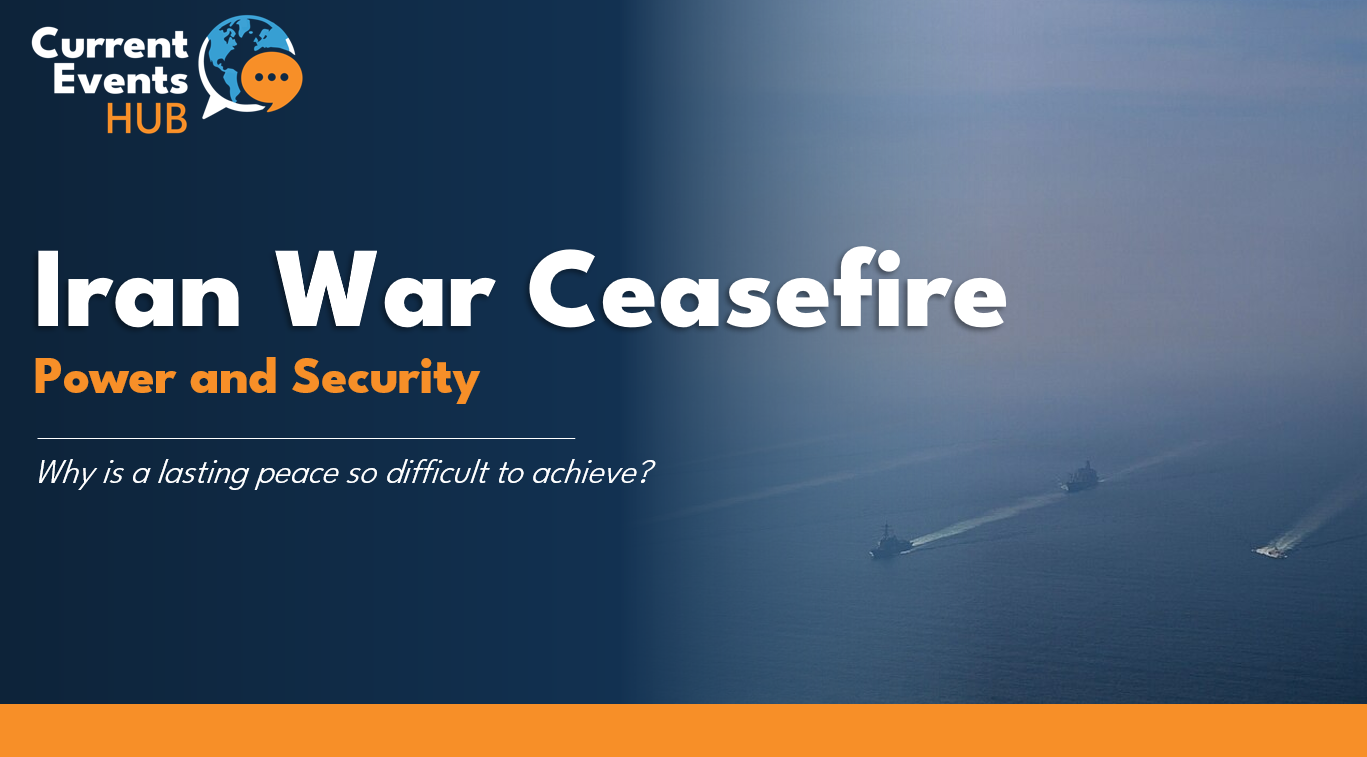
On April 7, 2026, the United States and Iran agreed to a two-week ceasefire, brokered not by the United Nations or a major world power, but by Pakistan. After more than five weeks of armed conflict, including US and Israeli strikes on Iranian infrastructure and Iran’s near-closure of the Strait of Hormuz, both sides stepped back from the edge hours before a US-imposed deadline expired.
But a ceasefire is not peace. The two sides remain far apart on the issues that started this conflict: Iran’s nuclear program, US sanctions, control of the Strait, and security guarantees for both parties.
This lesson uses the ceasefire as a case study in two questions: What does it take to stop a conflict? And what does it take to make peace last? Students examine what the US and Iran each want from the negotiating table, and explore the role Pakistan played as an external actor in bringing both sides together.
Included in this lesson:
- PowerPoint Slides with concept intro, discussion, and current event overview
- A separate ready-to-print PDF document for each lesson level
- Thinking questions to connect to the concepts of power and security
- Critical thinking activity about the challenges of achieving a lasting peace
- Research extension about the 2015 Iran Nuclear Deal
Lesson File Downloads:
Supporting Information:
Lesson Sources and Further Reading
Teacher Notes and Differentiation Tips
Key Misconceptions to Address
- Students may conflate ceasefire with peace. Be explicit that this is a 14-day pause, not an agreement, and that many ceasefires collapse.
- Students may assume Pakistan is a “neutral” party; in fact, it has its own geopolitical interests (avoiding regional escalation on its borders, maintaining US military aid relationships, asserting diplomatic relevance).
- Students may assume the nuclear issue is simple (“just don’t build the bomb”). Help them see Iran’s argument: nuclear capability as a deterrent and a sovereignty claim, not just a weapons program.
Sensitivity Risks
- Students from Muslim-majority backgrounds may have strong feelings about US/Israeli military actions. Acknowledge civilian harm directly and factually; do not editorialize.
- Students may arrive with strong partisan views on Trump’s role — keep the analysis at the level of state interests and structural incentives, not personality.
- The conflict involves ongoing civilian casualties and infrastructure destruction. Use age-appropriate framing for Level 1; Level 3 students can engage with the legal and ethical dimensions more directly (e.g., targeting of civilian infrastructure as a potential war crime.
Differentiation Tips
- Level 1 students may benefit from a visual map showing the Strait of Hormuz, Iran, Pakistan, and the US naval presence.
- Level 3 students can be extended with the Wikipedia article on 2025–2026 Iran–US negotiations for a fuller timeline.
Curriculum Links
IB MYP (Global Politics / Individuals & Societies) Key concepts: Power, Sovereignty, Global Interactions. ATL skills: Thinking (analysis/evaluation), Communication (discussion norms), Research (sourcing live events).
IB DP Global Politics Unit 1 (Power, Sovereignty, International Relations); Unit 4 (Peace & Conflict). Connects to core concepts of power, legitimacy, and the HL topic of security. Suitable as a stimulus for Paper 2 structured analysis or HL extension case study brainstorming.
C3 Framework (US Social Studies) Dimension 1: Compelling Question — Why is it so difficult to turn a ceasefire into lasting peace? Dimension 2: Sourcing, contextualization, corroboration. Dimension 3: Evidence-based claims.
Common Core Literacy in History/Social Studies (Grades 6–12) Reading: Cite textual evidence, determine central ideas, analyze how authors present conflicting perspectives. Writing: Arguments with claims, evidence, and counterclaims.
AP Comparative Government / AP Human Geography State power, sovereignty, geopolitical conflict, global trade routes and interdependence, nuclear non-proliferation as international norm.
GCSE / A-level (UK) Global Politics: conflict and security; the role of international actors; realist vs. liberal internationalist frameworks. A-level students can be directed toward a realist analysis of the ceasefire as a power-interest calculation.
Canadian Provincial Social Studies (General) Social Studies 9–12: global citizenship, conflict resolution, governance, geopolitics, media literacy (comparing how CBC, Al Jazeera, and NPR frame the same events).
Australian Curriculum — HASS Geography and Civics: global interconnections, power and decision-making, peace and security.
Transferable skill strands (all frameworks): Inquiry and questioning · Sourcing and evidence · Claims-reasoning · Perspective-taking · Argument writing · Discussion norms · Media/civic literacy
How to Use Current Events Hub Lessons
This lesson is designed for mixed-ability classrooms and comes ready in three reading levels — so you can use one level with the whole class or differentiate across groups without extra prep.
Choose your timing:
| Format | Time | What’s included |
|---|---|---|
| Quick snapshot | ~20 min | Slides or reading + comprehension questions |
| Full lesson | ~60 min | Slides + reading + thinking activities |
| Extended inquiry | ~80 min | Full lesson + research extension task |
Simple Plans for Individual Teachers and Departments
Individual Monthly
$12/month
Full access to the lesson library
A flexible way to explore
Individual Annual
$99/year
One-week free trial
Best value for individual teachers
Department Annual
$249/year
Up to ten teachers with unique logins
Ideal for school budgets