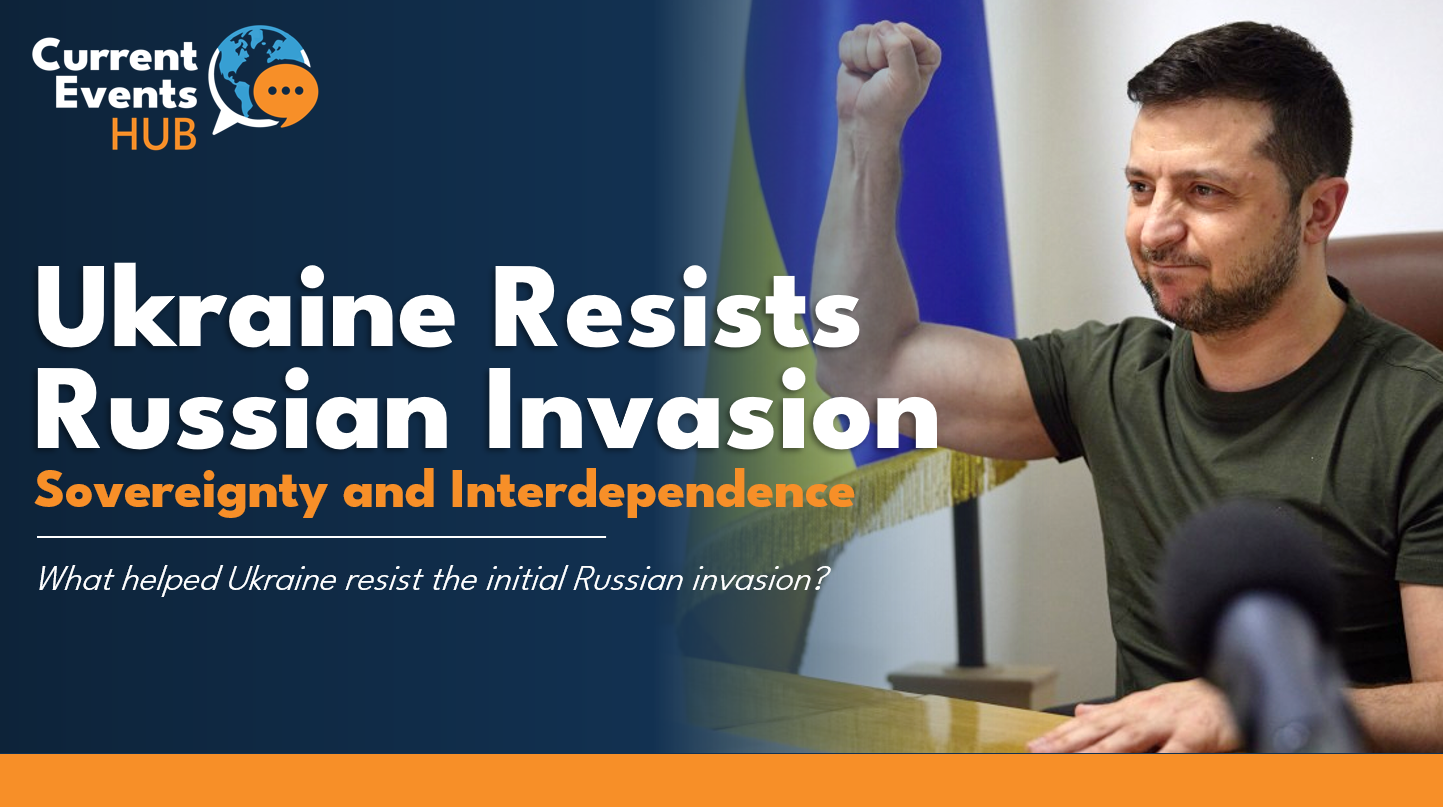
Why did Ukraine successfully defend Kyiv when US intelligence reportedly expected it to fall within days? In this lesson, students will explore five overlapping explanations:
- Ukrainian military preparation
- Resilience of Ukrainian society
- Failures in Russian planning
- International support
- Volodymyr Zelenskyy’s leadership and soft power
This is the third part of a mini-unit on the War in Ukraine. Use lessons individually or run them as a whole unit. Subscribers: click here to access all of the lessons.
Included in this lesson:
- PowerPoint Slides with concept intro, discussion, and current event overview with news clips
- A separate ready-to-print PDF document for each lesson level
- Thinking questions to connect to the concepts of sovereignty and interdependence
- Critical thinking activity about internal and external factors for Ukraine’s resistance
- Research extension about events in the first few weeks after the invasion
Lesson File Downloads:
Supporting Information:
Lesson Sources and Further Reading
CNN – US concerned Kyiv could fall to Russia within days, sources familiar with intel say
The Insider – RUSI: Russia’s plan to invade Ukraine failed due to high secrecy
The Syndicate – Joseph Nye: Soft Power After Ukraine
Kiel Institute – Ukraine Support Tracker (all the data on international support to Ukraine can be found here)
New Lines Magazine – The Global South’s Views on Ukraine Are More Complex Than You May Think
Teacher Notes and Differentiation Tips
Key Misconceptions to Address
- “Ukraine won.” The lesson is time-bounded to the initial invasion and the withdrawal from northern Ukraine by April 2022. As students should be made aware, the war’s outcome is not settled. Keep students focused on the question actually asked: what helped Ukraine resist the initial invasion.
- “Javelins and NLAWs saved Kyiv.” This is the single most persistent misconception, and RUSI’s analysis directly contradicts it: massed artillery fire from two brigades did the decisive work. Useful for showing how media narratives sometimes miss important facts.
- “Russia was always going to fail / Russia was incompetent.” RUSI’s finding is more interesting: the plan lacked fallback options, and Russia subsequently succeeded in Donbas operations once Ukraine’s ammunition was depleted.
- “The world united behind Ukraine.” Roughly 40+ states abstained or opposed. However, ~140 states voted to condemn, including ~60% of African states. Both show this is a complex issue.
- “Soft power means being liked.” Nye’s claim isn’t necessarily sentimental: attraction produces outcomes you would otherwise have to coerce or purchase. Just being liked doesn’t always mean your wishes will be delivered.
- “Aid is guaranteed.” Support has fluctuated substantially since 2022. The Kiel tracker shows both the scale and the volatility.
Sensitivity Risks
- Students with family in Ukraine or Russia. Likely in many classrooms. Keep the discussions analytical; do not invite personal testimony, and do not position any student as a representative of a country.
- The “why this war and not others?” question. A student may raise it, sometimes sincerely, sometimes to derail. It is a legitimate question and worth a short, honest answer: coverage and support are unevenly distributed, and scholars actively debate why. Then return to the inquiry question. Do not adjudicate it. This is the biggest European war since World War 2.
- Countries that voted with Russia framed as moral failure. Students may read abstention as cowardice, too. Redirect to interests these countries might have: arms dependencies, food and fuel imports, historical ties, and objections to perceived inconsistency in how norms are applied. It’s an interesting link to power, and why some countries feel compelled to vote in certain ways.
Differentiation Tips
- Level 1: Consider having students go through each of the factors and rate whether it helped a little or helped a lot. Make sure to clearly go over any challenging vocabulary.
- Level 2/3 students can benefit a lot from the further reading articles. Each one provides a deeper analysis of the different factors for Ukrainian resistance discussed in the reading. Consider assigning different groups a different article and then have them report back to build the internal/external chart with evidence from the articles.
Curriculum Links
IB DP Global Politics — Key concepts: sovereignty, interdependence, power; Thematic study: Peace and conflict (conflict dynamics and causes; justifications of violence); HL topic area: Security.
IB MYP Individuals & Societies — Key concept: Global interactions; Related concepts: power, causality, perspective; Global context: Fairness and development; Criterion A knowing and understanding, Criterion D critical thinking.
C3 Framework — D1 Developing Questions and Planning Inquiries; D2.Civ Civic and Political Institutions; D2.His causation and multiple causes; D3 Evaluating Sources and Using Evidence; D4 Communicating Conclusions (grades 6–8 and 9–12 indicators).
Common Core literacy in history/social studies — RH.6–8/9–10/11–12.1 cite textual evidence; RH.3 distinguish cause from mere sequence; RH.6 evaluate differing points of view by assessing claims, reasoning and evidence; RH.8 corroborate or challenge claims with other sources; RH.9 integrate diverse sources noting discrepancies; WHST.1 write arguments; SL.9-10.1 collaborative discussion.
AP Comparative Government & Politics — Big Ideas: Power and Authority (PAU), Internal/External Forces (IEF); Unit 1 Political Systems, Regimes, and Governments; Disciplinary Practices 4 Source Analysis and 5 Argumentation (anchor country: Russia).
Edexcel A Level Politics (9PL0) — Component 3: Comparative Politics (global politics; sovereignty and the international system); analysis and evaluation skills.
GCSE Citizenship Studies (Pearson Edexcel) — Theme E: the UK’s role in the wider world (international organisations, conflict, and forms of intervention); AO2 application and AO3 analysis and evaluation.
BC Social Studies 10 (Canada and the World: 1914 to the Present) — Big Idea (global and regional conflicts shape our contemporary world and identities); Content (international conflicts and co-operation); Curricular Competencies: cause and consequence, evidence, ethical judgment.
BC Political Studies 12 — Big Idea (political institutions and ideology shape the exercise of power and political outcomes); Content (scope and characteristics of the international system; political power in democratic and non-democratic societies); Curricular Competency: cause and consequence.
BC Social Studies 6 (Global Issues and Governance) — Big Ideas (international co-operation is needed for complex global problems); Content (globalization and economic interdependence; regional and international conflict); Curricular Competencies: perspective, evidence.
Alberta Social Studies 20-1 (Perspectives on Nationalism) — Related Issue 2 (national interest, self-determination and sovereignty movements — 2.9); Related Issue 3 (peace and security as motives in international affairs — 3.4); strands: Power, Authority and Decision Making, Global Connections; Skills S.1 critical thinking, S.7 deliberative inquiry.
Nova Scotia Global Politics 12 — Unit 4 International Relations (5.1 foundations of global interconnectedness; 5.2 UN, NATO and organizations governing relations; 5.5 obstacles to international relations); Global Citizen 1.1 critically investigate contemporary global political issues.
Ontario Canadian and International Politics (CPW4U) — international relations and the exercise of power; sovereignty and intervention; political inquiry and evaluation of sources.
Australian Curriculum Senior Secondary Modern History (v8.4) — Unit 4 The Modern World since 1945 (distinctive features of the contemporary world); concepts: cause and effect, contestability, perspectives; Historical Skills: analysis and use of sources.
New Zealand — Social Sciences (Te Mātaiaho, Phase 4) — Civics and Society strand (international relations and human rights instruments); Practices: constructing and evaluating explanations from evidence; Key Competencies: Thinking, Relating to others.
How to Use Current Events Hub Lessons
This lesson is designed for mixed-ability classrooms and comes ready in three reading levels. You can use one level with the whole class or differentiate across groups without extra prep.
Choose your timing:
| Format | Time | What’s included |
|---|---|---|
| Quick snapshot | ~20 min | Slides or reading + comprehension questions |
| Full lesson | ~60 min | Slides + reading + thinking activities |
| Extended inquiry | ~80 min | Full lesson + research extension task |
Simple Plans for Teachers and Departments
Monthly
Individual Annual
$8.25/month — save $45 vs monthly
One-week free trialDepartment Annual
Less than $25 USD per account
One-week free trial